
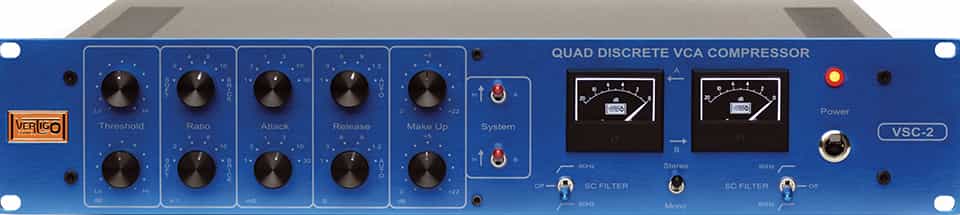
The Vertigo Sound VSC-2. Known for its ultra-clean signal path, hand-built VCA design, and mastering-grade transparency, it bridges the gap between vintage analog tradition and modern audio engineering.
History of the Vertigo Sound VSC-2
What Inspired the Creation of the Vertigo Sound VSC-2?
The Vertigo Sound VSC-2 was developed in Germany as a high-end stereo and dual-mono VCA compressor designed to deliver precise dynamic control without unwanted coloration. At its core lies Vertigo’s “Quad Discrete VCA” design — each channel contains two fully discrete, hand-built VCA circuits, one in the audio path and one in the side-chain. This configuration provides absolute control, channel balance, and low noise, making the VSC-2 suitable for everything from mix-bus compression to mastering applications.
The discrete VCA modules, called “1979,” pay homage to the golden age of analog design when engineers favored fully discrete circuits for their musicality and reliability. The VSC-2 inherited this spirit, combining it with the precision and stability expected from modern studio hardware.
What Makes the VSC-2’s Design Different from Other VCA Compressors?
Most VCA compressors rely on integrated circuit (IC) VCAs, such as the THAT 2180 series. The Vertigo VSC-2, however, uses its own proprietary discrete VCAs, built from individual components and potted for thermal consistency. This approach yields a cleaner, faster response with extremely low distortion — characteristics prized by mastering engineers who need transparent control.
The hardware includes premium components throughout: Jensen input transformers for signal integrity, Sifam VU meters for precision metering, and Grayhill rotary switches for repeatable settings. Its engineering excellence allows the unit to achieve both transparency and depth without exaggerating harmonics or low-frequency build-up.
Two defining operational modes extend its flexibility. The Soft mode features a variable ratio that increases gradually with input level, creating a smooth, “tip-toe” compression effect ideal for glueing a mix gently. In contrast, the Brick mode acts as a limiter with a harder knee for more aggressive dynamics control. Together, these options make the VSC-2 equally comfortable on the stereo mix bus, drum groups, or individual sources.
How Has the Vertigo Sound VSC-2 Evolved Over Time?
Since its release in the mid-2000s, the VSC-2 has become a benchmark among mastering-grade VCA compressors. Its precision and sonic neutrality positioned it as an alternative to character compressors, appealing to engineers who wanted analog control without coloration. Over the years, Vertigo Sound has maintained the same core circuitry, emphasizing longevity and consistency over frequent redesigns.
The company’s collaboration with Brainworx and Plugin Alliance led to a faithful software recreation of the VSC-2, capturing its fast response, dual-VCA topology, and signature “Soft” compression curve. This plugin version made the VSC-2 accessible to engineers working entirely in the digital domain, preserving the same workflow philosophy of clarity, precision, and musical dynamics.
Why Is the Vertigo Sound VSC-2 Considered a Modern Classic?
The VSC-2’s reputation stems from its ability to provide invisible dynamic control while maintaining musical depth and stereo coherence. Its dual-linked side-chain system ensures that both channels respond evenly to transient peaks, preserving the stereo image even under heavy compression, a critical trait for mastering and mix-bus work.
In the broader landscape of analog compressor/EQ design, the VSC-2 stands as a reminder that transparency can be as desirable as coloration. It embodies modern precision built on vintage engineering principles, ensuring that it remains a reference point in discussions of professional dynamics processing and vintage audio gear evolution.
Timeline
- Mid-2000s: Original hardware release of the Vertigo Sound VSC-2 Quad Discrete Compressor featuring custom “1979” VCA modules.
- 2011: Launch of the official Brainworx/Plugin Alliance software emulation.
- 2010s: Rapid adoption in high-end studios for mix-bus and mastering use.
- Today: Recognized globally as one of the most transparent and reliable VCA compressors in both hardware and software form.
Software Emulations
- Brainworx Vertigo VSC-2
- UAD Vertigo Sound VSC-2 Compressor
Tips and Techniques
-
Use “Soft” Mode for Subtle Mix-Bus Glue
Engage the Soft mode when you want transparent compression across a full mix. Set a medium attack around 30 ms and auto release, aiming for only 1–2 dB of gain reduction. This creates a cohesive mix-bus “glue” effect without dulling transients or reducing overall punch.
-
Preserve Transients with a Slower Attack
For drums, percussive instruments, or full mixes, use a slower attack to allow the transient to pass through before compression engages. This preserves attack and impact while still maintaining control over dynamic range — especially effective for kick and snare transients.
-
Switch to “Brick” Mode for Peak Limiting
Activate Brick mode when you need limiter-style behavior. Combine a faster release with a higher threshold to catch transient peaks without flattening the overall mix. It’s particularly effective for drum busses or mastering when precise peak control is required.
-
Engage Side-Chain Filtering to Protect the Low End
When compressing full-range material, use the side-chain high-pass filter to keep low frequencies from triggering compression. This prevents the kick or bass from causing unwanted gain reduction and maintains tight, punchy low-end energy in the mix.