
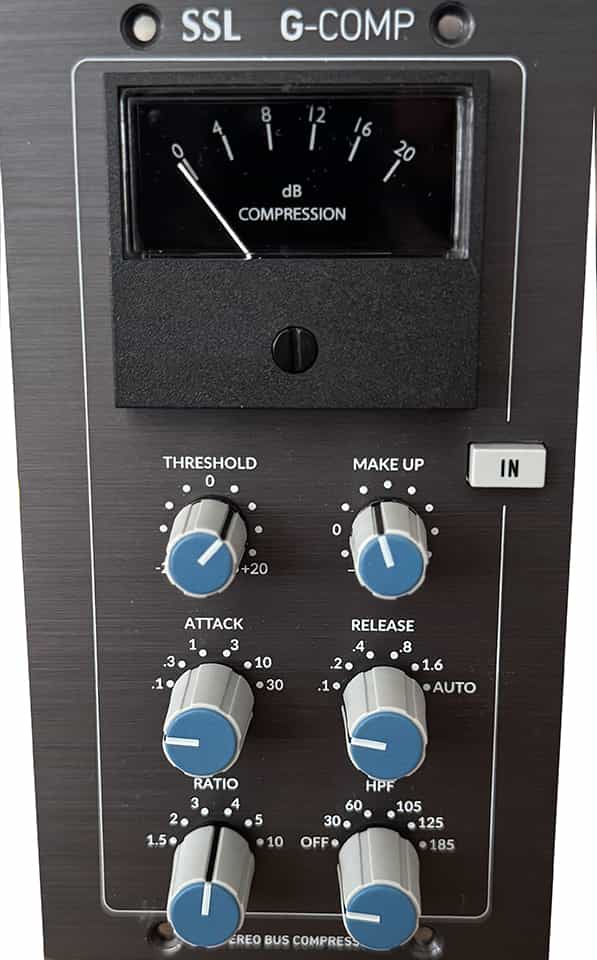
The SSL 4000 Bus Compressor is one of the most respected tools in recording history, known for adding cohesion and punch to a mix while maintaining clarity and balance. Its distinctive “glue” effect became synonymous with professional studio sound and continues to shape modern mixing workflows today.
History of the SSL 4000 Bus Compressor
What Is the SSL 4000 Bus Compressor and Why Is It Important?
The SSL 4000 Bus Compressor was introduced in the late 1970s as part of Solid State Logic’s groundbreaking SL 4000 Series consoles. Designed to apply transparent, musical compression across the stereo mix bus, it helped engineers control dynamic range and unify a mix into a cohesive whole. Its character—tight, punchy, and open—became instantly recognizable and set a new benchmark for analog compressor design.
Early Development
When SSL began developing the SL 4000 B console around 1976, the company sought to integrate advanced dynamics control directly into the mixing desk. Most studios at the time used outboard compressors individually patched into channels, but SSL engineers envisioned something new: a master bus compressor built right into the console’s center section. This would allow engineers to apply consistent compression across the full mix without additional routing.
The design employed a VCA (voltage-controlled amplifier) circuit based on the dbx 202 “black can” chip, a component known for precision and repeatability. Unlike tube or optical compressors, which rely on slower or nonlinear elements, a VCA circuit responds instantly to control voltages, making it ideal for transparent mix control. This precision gave the SSL Bus Compressor its defining clarity and fast response.
What Made the SSL Bus Compressor’s Design Innovative?
One of the key innovations of the SSL 4000 Bus Compressor was its “feed-forward” topology. Instead of reacting to the output signal, it analyzed the input, allowing the circuit to respond quickly to transients. This made it capable of preserving punch while controlling peaks, a rare balance at the time.
Another breakthrough was the Auto release mode. Rather than setting a fixed release time, this mode adapted dynamically to the music’s envelope, providing natural compression behavior that felt musical rather than mechanical. Combined with its selectable ratios, particularly the now-famous 4:1 setting, the SSL achieved a mix glue effect that brought cohesion without dulling the sound.
Key Revisions and Milestones
As SSL consoles evolved, so did the Bus Compressor. The SL 4000 E and G series refined the circuit for better noise performance and improved stereo tracking. Later versions transitioned from the original dbx VCAs to THAT Corporation components, which offered lower distortion and greater linearity.
By the late 1980s, SSL began offering the Bus Compressor as a standalone 1U rack unit, freeing it from the console and allowing studios to integrate the circuit into a variety of setups. This standalone version—the SSL G Series Bus Compressor—became an instant favorite among mastering engineers and remains a studio staple today.
When Did the SSL Bus Compressor Become a Studio Standard?
By the 1990s, the SSL 4000 and its Bus Compressor had set the sonic standard for professional mixing. Its ability to “glue” the elements of a mix together became part of the SSL console’s identity. Even as digital recording emerged, engineers sought out the SSL sound, leading to a wave of plugin emulations in the 2000s and beyond.
Legacy and Influence
The SSL 4000 Bus Compressor has influenced nearly every subsequent VCA-style compressor on the market. Its blend of precision, musicality, and punch continues to define professional audio production. Whether used on a full mix, drum bus, or subgroup, its sonic signature remains a symbol of balance and cohesion in analog and digital workflows alike.
Timeline of the SSL Bus Compressor
- 1976 — SSL 4000 B console debuts with the first integrated bus compressor.
- 1981 — SSL 4000 E console refines the compressor design and control range.
- 1987 — SSL 4000 G series introduces the G Bus Compressor circuit and new VCAs.
- 1994 — SSL releases the standalone G Series rackmount version.
- 2000s — Plugin emulations from SSL, Waves, UAD, and others make the design globally accessible.
- 2019–present — SSL reissues modern hardware and hybrid designs such as the Bus+ and Fusion.
Software Emulations
- Cytomic The Glue
- IK Multimedia Bus Compressor
- Native Instruments Solid Bus Comp
- SSL Bus Compressor 2
- UAD SSL 4000 G Bus Compressor
- Waves SSL SSL G-Master Buss Compressor
Tips and Techniques
-
Classic “Glue” Mix Bus Setting
Use the standard settings: 4:1 Ratio, 30ms Attack, Auto Release. Adjust the Threshold to achieve only 1–2dB of gain reduction, primarily on the loudest peaks.
-
Enhance Transients with Slower Attack
Set the Attack time between 10ms and 30ms to allow the initial transient (the “snap”) of drums and percussion to pass through uncompressed, thereby maximizing perceived energy and punch.
-
Use the Auto Release for Complex Material
Engage the Auto Release setting when processing the full mix or a complex stem. This program-dependent feature prevents “pumping” and ensures the compressor’s gain reduction organically follows the dynamic changes of the track.
-
Apply Parallel Compression for Density
Use the Mix (Wet/Dry) control available on most plugins to blend a heavily compressed signal (fast attack, fast release, high ratio) with the original track. This mixing technique adds density and apparent loudness while preserving the clarity of the transients.
-
Manage Low-End Pumping with SC HPF
To prevent low-frequency energy (kick drum or bass) from unnecessarily triggering the compression, activate the sidechain high-pass filter (SC HPF) at 80–120Hz. This maintains solid low-end stability on the master bus.
-
Tighten Subgroups with Fast Settings
For aggressive drum or parallel compression subgroups, use a faster Attack (1ms or 3ms) and a faster Release (0.1s to 0.3s) with a ratio of 4:1 or 6:1. Aim for 3–5dB of gain reduction to create a tight, consistent dynamic response.
-
Achieve Transparency with the 1.5:1 Ratio
For subtle dynamic control, particularly on acoustic tracks, use the lowest ratio (1.5:1). This provides almost imperceptible gain reduction that gently tightens the material without altering its dynamics or tone.
-
Mix Into the Compressor
Adopt the foundational recording technique of placing the SSL Bus Compressor on the mix bus at the start of your mixing session. After an initial rough balance, make all your level, volume, and EQ decisions with the compressor active and fine tuned. This ensures you are working with the interactions of the tracks.