
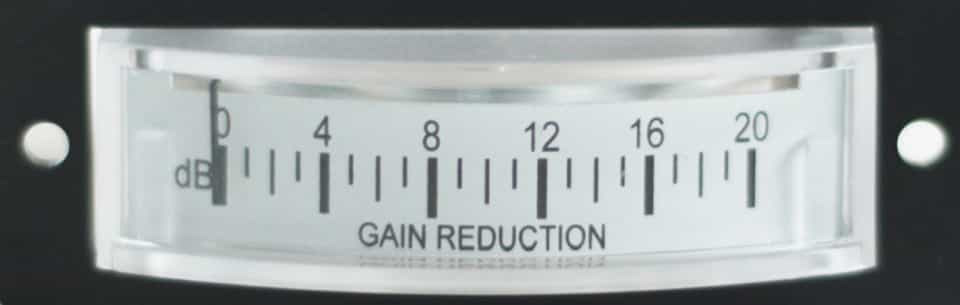
Compressors are clever bits of electrical wizardry that smooth out dynamics and add character. But not all compressors behave (or sound) the same. Each design—diode-bridge, FET, VCA, optical, vari-mu, and PWM—has its own unique quirks and uses.
Table of Contents
- Diode-Bridge Compressors
- FET Compressors
- VCA Compressors
- Optical Compressors
- PWM Compressors
- Variable-Mu Compressors
- Quick Compressor Comparison
What an Audio Compressor Actually Does
At its core, a compressor automatically turns down the volume of loud sounds and lets the quiet ones come up. It does this by applying gain reduction based on a control voltage, a signal that tells the compressor “how hard to work.” Different circuit designs generate and apply that control in completely different ways, which is why compressors all sound different. Understanding those inner workings can help in deciding which one to use!
Diode-Bridge Compressors
How They Work
Diode-bridge compressors rely on a network of diodes — tiny one-way electrical gates — arranged in a balanced bridge configuration. When current passes through the diodes, their natural resistance changes depending on voltage. By feeding a sidechain control voltage into the bridge, the circuit varies how much signal gets through. Because diodes are wonderfully nonlinear creatures, they don’t behave perfectly — and that imperfection adds character. Transformers usually bookend the circuit, keeping everything balanced while adding their own subtle saturation and warmth.
When audio enters the compressor, it splits into two paths: the main audio path and the sidechain detection path. The sidechain analyzes the signal level and generates a control voltage. That voltage determines how strongly the diodes conduct — as the control voltage increases, the diodes conduct more unevenly, reducing gain in a musically “squishy” way. The circuit’s balanced bridge format cancels some distortion, but not all — the small irregularities left behind become the signature tone.
Attack and release times are typically governed by capacitor networks in the sidechain, which can produce slower, rounded envelopes. The combination of diode conduction curves, transformer coloration, and slightly delayed control voltage creates the thick, gluey, subtly gritty dynamic movement diode-bridge units are loved for.
History
The diode-bridge design came to fame in the late 1960s with Rupert Neve’s 2254 and later the 33609. Those big, iron-filled boxes helped define the polished, punchy sound of British rock and broadcast mixing for decades. Engineers fell in love with their smooth but weighty compression, and that affection has never faded.
Sound and Sonic Characteristics
Diode-bridge compressors don’t just control dynamics; they make tracks feel cohesive and bold. Great for drums, bass, and mix buses when you want weight and feel, not clinical precision.
Famous Hardware Designs
-
- Neve 2254
- Neve 33609
- Rupert Neve Designs 535
- Chandler Limited TG-1
FET Compressors
How They Work
FET (Field Effect Transistor) compressors use a transistor that acts like a voltage-controlled resistor. The sidechain generates a control voltage that hits the FET’s “gate,” adjusting how much current flows through it. Because transistors switch incredibly fast, FET compressors react almost instantly to peaks. This makes them ideal for catching sharp transients before they bite your ears off. The tradeoff? That same speed introduces a bit of harmonic grit — which, in the right hands, sounds great.
Inside, the audio signal feeds a transistor biased to operate in a region where small changes in gate voltage produce large changes in conductivity. The sidechain rectifies and filters the input to generate a fast-responding control voltage. When the input signal rises, the sidechain rapidly increases this voltage, pushing the FET toward higher resistance and reducing the audio signal level. Because FETs behave somewhat like tubes in the way they saturate and distort, transient peaks getting clamped can generate pleasing harmonic overtones.
Attack and release circuits are often simple RC networks, allowing ultra-short attack times and snappy, explosive releases. Output transformers (on many classic units) add another tiny layer of harmonic color and punch, contributing to the unmistakable “grab and smack” feel.
History
Enter the Urei 1176. Designed by Bill Putnam in 1967, it brought lightning-fast compression and a distinct, forward tone to every major studio. From powerful drums to modern pop vocals, the 1176 remains the gold standard for punch and attitude.
Sound and Sonic Characteristics
Bright, aggressive, and full of life. FET compressors add energy and presence while keeping peaks in check. Push them and they’ll reward you with a snappy, slightly saturated sound that practically jumps out of the speakers. Subtlety? Not their strong suit!
Famous Hardware Designs
VCA Compressors
How They Work
VCA (Voltage Controlled Amplifier) compressors are the engineers’ dream: precise, controllable, and reliable. They use an integrated circuit where gain changes are directly proportional to a control voltage from the sidechain. The VCA itself acts as a near-perfect volume knob driven by math. Depending on whether it’s designed in a feedforward (input-based) or feedback (output-based) configuration, the behavior can range from ultra-tight to smooth and musical.
Here’s the signal flow: the incoming audio splits, one copy enters the VCA audio path, the other feeds the detection circuit. The sidechain rectifies and filters the waveform to calculate level, then generates a control voltage that tells the VCA exactly how much to reduce gain. Unlike diode or FET designs, VCAs introduce extremely predictable gain changes, meaning precise ratios, knee shapes, and timing curves.
Attack and release circuits can be very fast or deliberately slow depending on capacitor and resistor choices. Feedforward circuits “look ahead” and are more surgical and modern; feedback circuits “listen” to the output, delivering rounder, more classic behavior. Their linearity, low noise floor, and timing control make VCAs central to mixing consoles and mastering chains.
History
dbx made the first famous VCAs in the 1970s, bringing compression to consoles and outboard gear everywhere. Then SSL took things further by adding a VCA compressor to their console’s master section: the famous “G Bus” compressor that glued entire mixes together. By the 1980s, every big studio had one permanently set up across the stereo bus.
Sound and Sonic Characteristics
Clean, punchy, and consistent. VCAs are studio workhorses, they can be transparent or aggressive depending on settings. Their fast and predictable response makes them perfect for mix buses, drums, and mastering when you need both control and cohesion.
Famous Hardware Designs
Optical Compressors
How They Work
Optical compressors (or “opto” for short) use a light source and a light-dependent resistor (LDR) to control gain. The louder the signal, the brighter the light glows, and the more resistance the LDR applies to reduce gain. Because light doesn’t change instantly — it fades in and out — optical compressors have naturally smooth, musical attack and release times. They react to sound naturally and gently.
At the core of the circuit is an electro-optical attenuator: a tiny light source (often an electroluminescent panel or LED) paired with a photosensitive resistor. Audio triggers the sidechain, which lights the lamp proportionally to level; the LDR darkens or brightens accordingly, changing resistance and reducing gain. The light element has persistence, it takes time to glow and time to dim, creating the famous “two-stage” release curve: a quick initial recovery followed by a slower tail. The audio path often uses tubes and transformers, each adding warmth, soft saturation, and gentle leveling. Because the optical cell is inherently nonlinear, compression curves shift subtly depending on how hard the circuit is hit, lending organic dynamic movement.
History
The Teletronix LA-2A, introduced in the early 1960s, set the standard. Built with tubes, transformers, and an electroluminescent panel, it became a vocal favorite for its smooth response and tone. To this day, it’s one of the most emulated compressors ever made.
Sound and Sonic Characteristics
Smooth and forgiving. Optical compressors don’t clamp down, they caress. They’re ideal for vocals, bass, and acoustic instruments, adding natural subtle leveling without audible pumping.
Famous Hardware Designs
PWM Compressors
How They Work
PWM (Pulse Width Modulation) compressors take a more high-tech route. Instead of directly changing resistance or voltage, they turn the audio signal into a high-speed stream of on-off pulses. The width of each pulse represents the signal’s amplitude, and a control voltage modulates those widths to apply compression. After that, the signal is smoothed back into analog audio with filters. The result is compression that’s absurdly fast, clean, and linear — basically, the superhero version of a VCA.
Internally, the incoming audio is converted into a pulse train at a very high frequency — far above audible range. The sidechain computes level and alters the duty cycle (pulse width) so that louder signals get narrower pulses (less average energy) and quieter signals remain wider. A precision low-pass filter then reconstructs the audio waveform. Because the control happens in the time-domain with digital-like precision, PWM can achieve extremely fast attack times, razor-accurate release curves, and extremely low distortion. The gain control element never slew-limits or saturates like an FET, diode, or opto element — which is why PWM designs sound so clean and neutral. Timing constants often use sophisticated envelope circuits, enabling mastering-grade control of micro-dynamics.
History
PWM concepts surfaced decades ago, but it wasn’t until the 1990s that companies like Crane Song harnessed the approach for high-end analog mastering compressors. The technology’s accuracy and lack of distortion earned it a quiet but loyal following among engineers who prize transparency above all else.
Sound and Sonic Characteristics
Transparent and precise. They’re ideal for mastering and classical or orchestral work, where preserving tone is everything.
Famous Hardware Designs
-
- Crane Song STC-8
- Pye 4060
Variable-Mu Compressors
How They Work
Variable Mu (short for “variable gain, variable bias,” from the Greek letter μ which is a symbol for gain) compressors use vacuum tubes as the gain-reduction element. Instead of altering resistance or pulse width, Variable Mu designs change the tube’s bias — the electrical operating point inside the tube — to control amplification. As the input signal rises, the control voltage shifts the tube’s bias so it naturally transfers less gain. This continuously variable tube bias is where the name “Variable Mu” comes from.
Signal flow: audio enters the tube amplification stage while a duplicate signal feeds the sidechain detection circuit. The sidechain rectifies and filters the signal, generating a DC control voltage. This voltage pushes the tube into a different operating region, reducing its amplification factor as level increases. Unlike hard-switching transistors, tubes compress gradually — the gain reduction curve gently bends into place rather than slamming down.
Attack and release behavior depends on timing capacitors and the tube’s inherent response curve. Release often has a smooth, dual-stage feel — a fast initial recovery followed by a slow “settling” tail. Transformers typically sit at the input/output, adding low-frequency heft, a gentle high-end roll-off, and subtle saturation. When pushed, tubes introduce rich, even-order harmonics and velvety soft clipping, creating the lush “glow” Variable Mu compressors are known for.
The result? A constantly adapting gain stage with natural-sounding compression.
History
Variable Mu designs trace back to early broadcast and mastering tube limiters from the 1950s and 1960s. Fairchild set the benchmark with its legendary 660 and 670 limiters, designed by Rein Narma and famously used by The Beatles and Motown engineers. Manley revived and modernized the format in the 1990s with the Manley Variable Mu.
Sound and Sonic Characteristics
Variable Mu compressors don’t just tame peaks, they can make the signal feel like it is gently settling into place. Perfect tracks where natural motion and tone enhancement matter more than aggressive peak control.
Famous Hardware Designs
Quick Compressor Comparison (with pesky over-generalizations!)
| Compressor Type | Best Uses | Why It Works Best |
|---|---|---|
| Diode-Bridge | Adding warmth, punch, and mix cohesion | Nonlinear diode behavior and transformer coloration add thick harmonics and vintage glue |
| FET | Fast transient control and aggressive character | Lightning-fast response with saturated tone for punchy, energetic compression |
| VCA | Precise dynamics control and mix glue | Highly accurate voltage control allows consistent, adjustable, and versatile compression |
| Optical | Smooth leveling for vocals and bass | Light-based gain reduction naturally follows performance dynamics with soft, graceful response |
| Variable-Mu | Glue and tone enhancement | Tubes gently change gain with level, producing warm saturation and organic, breathing compression |
| PWM | Transparent mastering and precision dynamics | Pulse-width control achieves extremely fast, linear compression with ultra-low distortion |
Remember!
Compression isn’t just about control — it’s about character. The right compressor becomes part of your sound’s personality. Knowing how each one works isn’t just trivia; it’s the key to unlocking better mixes with better feel.